Someone messages your business at 10:14 AM.
“How much for a consultation?”
You reply with the price. They say, “Okay, thanks. I’ll think about it.”
Then nothing.
You don’t chase them because it feels pushy. By evening, the chat is buried under supplier updates and family messages. Two days later, that lead is gone.
This happens in salons, gyms, dental clinics, real estate offices and coaching businesses every day. The fix is usually not more ads. It’s what you do after the enquiry lands.
This guide walks you through a simple WhatsApp lead follow-up system. You’ll get a 7-day sequence you can copy today.
Why do WhatsApp leads go cold?
Most leads don’t say no. They just go quiet. Here are the four most common reasons:
- You replied too late. The person was ready to book at 10 AM. By 4 PM, they’d messaged three of your competitors.
- The enquiry got buried. WhatsApp mixes customers with friends, family and suppliers. Without labels or a tracker, leads slip through.
- You didn’t know what to say next. So you sent “Hi, just checking in,” or you sent nothing.
- You followed up once and stopped. One nudge is rarely enough. A quiet lead is usually a pause, not a rejection.
WhatsApp is where your customers already are. Meta-cited figures say about 80% of small business owners in India and Brazil use it to talk to customers. So your competitors are in the same inbox, and the one who follows up properly usually wins.
How fast should you reply to a WhatsApp enquiry?
Reply within 5 minutes if you can.
The best-known research here is the MIT and InsideSales.com Lead Response Management study (2007). It found that contacting a web lead within 5 minutes, instead of 30, made a business roughly 100 times more likely to reach them and 21 times more likely to qualify them.
Be fair about what that shows. The study covered B2B web leads and phone calls, not WhatsApp chats with salon clients. But the lesson carries over: the first business to respond usually has the advantage.
You don’t have to be glued to your phone. A saved first-reply template and a quick-reply shortcut get you there in under a minute.
What is a WhatsApp lead recovery system?
A WhatsApp lead recovery system is a repeatable process for handling every enquiry from first message to booking and beyond. It replaces memory and improvisation with set steps, ready messages and one place to track who needs attention.
A good one has seven steps:
Most businesses do step one and step five on a good day. The money is in the steps between.
What is a good 7-day WhatsApp follow-up sequence?
Here is a simple sequence you can use today. Swap the [brackets] for your details.
| When | Goal | Message |
|---|---|---|
| Day 0 (within 5 minutes) | Reply and qualify | “Hi [Name], thanks for reaching out about [service]! Quick question so I send you the right details: [qualifying question]?” |
| Day 1 | Give value and an easy choice | “Hi [Name], here are the details for [service]: [price or range]. Does [Option A] or [Option B] sound closer to what you need?” |
| Day 3 | Soft check-in with a slot | “Hey [Name], still looking for help with [service]? I have two openings on [day] and [day]. Want me to hold one for you?” |
| Day 5 | Answer the hidden worry | “Hi [Name], lots of people ask us about [common worry]. Short answer: [one clear line]. If that was holding you back, happy to sort it out.” |
| Day 7 | Close the loop politely | “Hi [Name], I’ll close your enquiry for now so I don’t keep messaging you. If you’d like to pick this up later, just reply here.” |
Why does this work?
- Every message has a reason to exist. It never just says “any update?”
- Every message is easy to answer. A choice between two options beats an open question.
- The last message respects their time, which often prompts a reply.
This is the basic shape of the 7-day system inside the Playbook, which adds 10+ variations for each stage.
How many times should you follow up on WhatsApp?
There’s no magic number, but 4 to 5 messages over about 7 days is a sensible range for most local service enquiries. That is my recommendation, not a rule.
The principle matters more than the count. Each follow-up should add something new, like a slot, an answer or a next step. Stop when the customer replies, books or asks you to stop.
If you use the WhatsApp Business API through a platform, Meta’s 24-hour customer service window and template rules also apply. Check your provider’s guidance. The free WhatsApp Business app doesn’t work that way, so you can message manually.
Always respect consent and privacy. Only message people who contacted you or agreed to hear from you.
How do you follow up on WhatsApp without being pushy?
Use three rules:
- Add context. Mention what they asked about.
- Add value. Give a slot, a tip, a photo or an answer.
- Add direction. End with one easy next step.
Compare these two messages:
“Hi, just following up.”
“Hey Priya! Checking on your Saturday bridal enquiry. We only take 2 bookings a weekend. Want me to hold the 11 AM slot?”
The second one is specific and easy to answer. It sounds like a helpful person, not a pushy one.
What do you say when a customer says “it’s too expensive” or “I’ll think about it”?
Don’t argue, and don’t drop your price straight away. Ask a gentle question to find the real reason.
Both replies keep the chat open. They also tell you what’s really stopping the sale, so you can answer the right worry.
How does WhatsApp follow-up work for different local businesses?
The system stays the same. The details change.
- Salons and beauty: Clients ask the price of colouring or bridal packages, then vanish. Ask for a photo of their current hair and offer two time slots right away.
- Gyms and fitness: Trial and membership enquiries need a fast reply and a nudge toward a visit, not a long pitch.
- Dental clinics: People ask about treatments and costs, and they often hesitate. Clear answers and an easy booking step help.
- Real estate: Agents juggle many enquiries at once. A tracker and timed follow-ups keep each buyer moving.
- Coaches and consultants: The goal is a consultation call. Qualify first, then offer two call times.
How do you track WhatsApp leads without a CRM?
You don’t need fancy software. A simple sheet is enough. Track these columns:
- Customer name and enquiry source
- Service requested and what they need
- Lead status (new, follow-up needed, booked, recovered)
- Last contact and next follow-up date
- Booking status, expected value and notes
Spend five minutes at the end of each day checking who needs a message tomorrow. That small habit stops most leads from slipping away.
Can AI write your WhatsApp follow-up messages?
Yes, if you give it real context. A generic prompt gives you generic messages, and customers can tell.
Always read and edit the result before you send it. The Playbook includes 20 AI prompts built around the customer’s requirement, the objection, the follow-up stage and your tone.
What is the WhatsApp Lead Recovery Playbook?
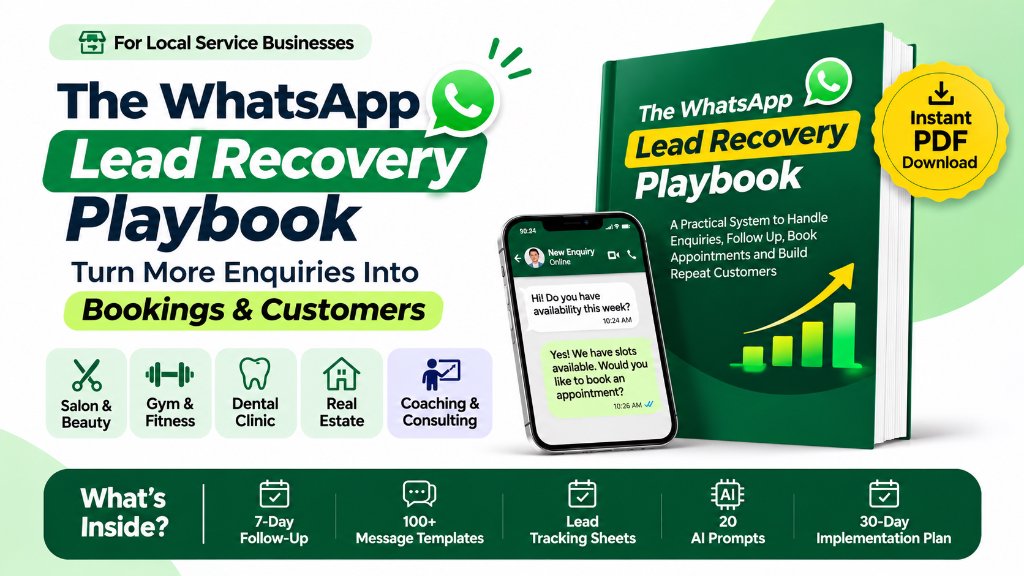
The WhatsApp Lead Recovery Playbook is an instant-download PDF from Diginite Store. It’s built for local service businesses that get enquiries on WhatsApp. You open it when a customer messages, find the situation, edit the message and send it.
What you get inside
- • A 7-day WhatsApp follow-up system
- • 100+ ready-to-customize message templates
- • First-response templates & qualification framework
- • Price objection responses
- • Missed enquiry recovery messages
- • Appointment booking & confirmation scripts
- • Review request & repeat booking messages
- • 20 AI prompts
- • Lead & appointment tracking worksheets + calendar
- • WhatsApp Business setup checklist & 30-day plan
One-time payment, no subscription, unlimited team use.
| Without a system | With the Playbook |
|---|---|
| Forgetting to follow up | A clear follow-up schedule |
| Writing every reply from scratch | Ready-to-edit templates |
| Losing track of enquiries | A simple lead tracker |
| Not knowing what to say | Response frameworks |
| Giving up after one message | A structured 7-day sequence |
Who it’s for: Salon owners, gym owners, dental clinics, real estate agents, coaches, consultants and other local service businesses that get customer enquiries.
Who it’s not for: Anyone who doesn’t get enquiries, wants a magic script that guarantees sales, or won’t adapt the templates to their business.
Be realistic about results. The Playbook gives you a system, messages and tools. Your results still depend on your offer, price, demand, service quality and how consistently you use it. It doesn’t guarantee sales or bookings, and it isn’t automation software. You copy, edit and send messages yourself.
Final thoughts
You probably don’t need more enquiries. You need a better plan for the ones already sitting in your inbox.
Reply fast. Ask before you quote. Follow up with a reason. Track who needs attention. Do that every day and fewer good leads will disappear.
If you’d rather not build it from scratch, the WhatsApp Lead Recovery Playbook gives you the messages, worksheets and 30-day plan in one PDF. You can also browse more creator and business kits in the Diginite Store catalog.
Sources: MIT/InsideSales.com Lead Response Management Study (Oldroyd, 2007); Harvard Business Review, “The Short Life of Online Sales Leads” (2011); SleekFlow, “WhatsApp follow up: how to follow up without breaking the rules”; ThisAndThat, “13 WhatsApp Business Statistics for 2026” (Meta-cited small business figure).
Disclaimer: Results vary by business. Not affiliated with or endorsed by Meta or WhatsApp.