You find a stock that looks great. You skim a few headlines, check one chart, and jump in. Two days later you’re down, and you can’t remember why you entered in the first place.
Sound familiar?
Most traders, new and experienced, struggle with the same things. Research is scattered. Decisions are driven by mood. The strategy lives in your head instead of on paper. Risk management gets skipped when a trade feels exciting.
This is where an AI trading prompt pack can help. Not by predicting the market. Not by handing you winning trades. It helps you ask better questions, organize your thinking, and follow a process you can repeat.
Why Trading Decisions Get Emotional and Inconsistent
Markets move fast. Your emotions move faster.
When money is on the line, your brain reacts. A winning trade makes you feel invincible, so you size up. A losing trade stings, so you chase it back. Fear makes you exit too early. Greed makes you hold too long.
Here’s the real issue. It usually isn’t a lack of intelligence. It’s a lack of structure. Without written rules, every decision gets made in the moment, and the moment is when emotions are loudest.
Think of two traders, both USD 1,000 up on a good week. One wrote down why they entered, where they’d exit, and how much they’d risk. The other just “felt good” about it. Next week, the first trader can review and learn. The second can only guess.
(All dollar figures in this article are simple examples. Adjust them to your own currency, account size, and risk tolerance.)
Emotional vs. Rule-Based Decision-Making
| Decision Area | Emotional Decisions | Rule-Based Decisions |
|---|---|---|
| Entry | “It feels like it’s going up” | Entry checklist is met |
| Exit | Panic or hope | Planned before the trade |
| Position size | Changes with mood | Set by a risk rule |
| After a loss | Revenge trade | Review, then move on |
| Learning | Hard to track | Clear notes to study |
Rules don’t remove emotion. They give emotion less room to run the show.
How AI Can Support Trading Research and Planning
AI tools like ChatGPT are good at a few things that matter for traders. They organize information, explain concepts in plain language, build checklists, and help you think through “what if” scenarios.
That makes them useful for AI trading research and planning. Here’s what that looks like in practice:
- Explaining a term you don’t understand, like “support and resistance” (price levels where a market has often paused or reversed)
- Turning a messy idea into a clear, written plan
- Creating a pre-trade checklist
- Spotting gaps in your reasoning
- Summarizing your trade journal entries to find patterns
Manual Research vs. AI-Assisted Research
| Factor | Manual Research | AI-Assisted Research |
|---|---|---|
| Speed | Slow, many tabs open | Faster first draft of ideas |
| Structure | Often random | Follows a set framework |
| Consistency | Changes day to day | Repeatable process |
| Blind spots | Easy to miss them | AI can ask what you skipped |
| Final decision | Yours | Still yours |
Notice the last row. AI supports your thinking. It doesn’t replace it.
What Is an AI Trading Prompt Pack?
A prompt is simply the instruction you type into an AI tool. A vague prompt gets a vague answer. A clear, structured prompt gets a far more useful one.
An AI trading prompt pack is a ready-made collection of those structured prompts, built for trading tasks. You copy a prompt, fill in your details, paste it into your AI tool, and get an organized response you can actually use.
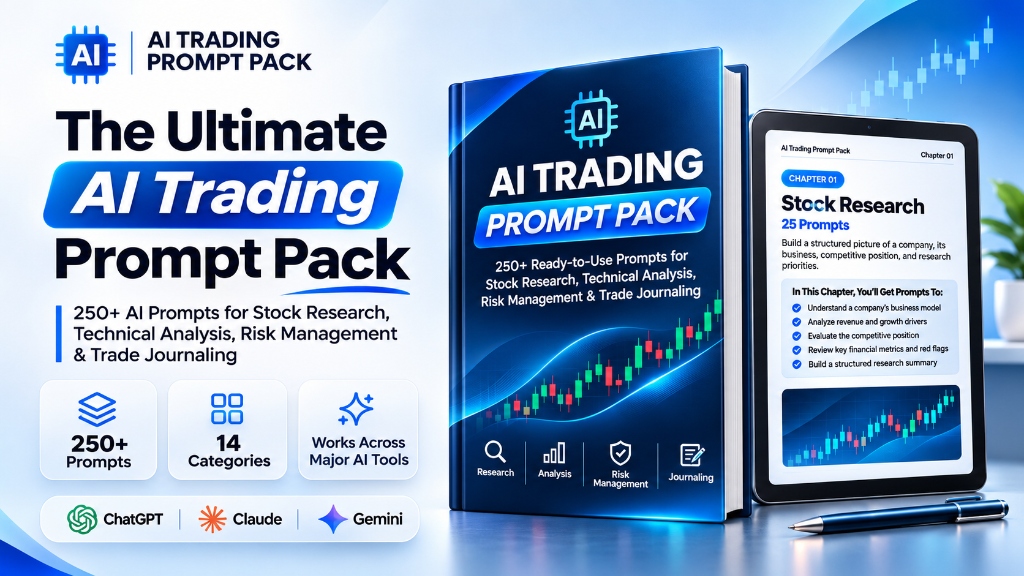
The AI Trading Prompt Pack from Diginite is a digital PDF with 250+ prompts across 14 categories, covering stock research, technical analysis, risk management, and trade journaling.
Let’s be very clear about what it is not:
- It is not automated trading software
- It is not a signal service
- It is not financial advice
- It is not a promise of profit
It’s a toolkit for building better preparation habits. You stay in charge of every decision.
Who This Is For
This kind of pack fits you if you’re:
- A beginner trader who doesn’t know what to ask AI or where to start
- An intermediate trader who has a strategy but struggles to follow it
- An aspiring trader still learning and wanting a structured way to study
- A side hustler with limited time who needs efficient research
- An investor who wants a clearer process for evaluating ideas
- Someone already using ChatGPT but getting vague, generic answers
It’s probably not for you if you want someone to tell you what to buy, or you expect a shortcut to profits. No honest product can offer that.
Practical Ways to Use AI Prompts for Trading
Here are five practical areas, each with a sample prompt you can try today. Replace the brackets with your own details.
1. Market Research
Good research starts with good questions. Instead of asking “Is this stock good?”, ask for a framework.
This is one of the best AI prompts for trading research because it asks for a process, not an opinion.
2. Trade Journaling
A journal is the fastest way to improve, and the one most traders skip. These trading journal prompts make it easier.
Real-life example: a trader notices through this kind of review that most of their losses happen on trades entered right after a big win. That’s a habit, not a market problem. And habits can be fixed.
3. Strategy Development
Many traders say they “have a strategy” but can’t write it down. Try it.
These trading strategy prompts turn a vague idea into a written document you can test and refine.
4. Risk Management
Risk management is what keeps you in the game. Here’s a simple example using USD.
If your account is USD 5,000 and you decide to risk no more than 1% per trade, your maximum loss on one trade is USD 50. That one rule protects you from a bad streak wiping you out.
Using risk management prompts for traders like this builds the habit of calculating before clicking.
5. Trade Reviews and Psychology
After a trade closes, the real learning begins.
For the mental side, trading psychology prompts can help you spot emotional triggers.
Build a Simple Trading Routine With AI Prompts
A good AI trading workflow doesn’t need to be complicated. Here’s a routine you can run in about 20 to 30 minutes a day.
- Before the market (10 minutes): Use a research prompt to build your checklist for the assets you’re watching.
- Before each trade (5 minutes): Run your pre-trade checklist. Calculate position size with a risk prompt. If something doesn’t fit your rules, skip it.
- After each trade (5 minutes): Log the trade in your journal with your reason, result, and how you felt.
- End of week (15 minutes): Paste your journal entries into a review prompt and look for patterns.
- Monthly: Revisit your strategy and adjust one thing at a time.
Trading Without a Process vs. With AI-Supported Prompts
| Stage | No Structured Process | AI-Supported Prompts |
|---|---|---|
| Preparation | Rushed and random | Same steps every time |
| Risk | Decided on the spot | Calculated in advance |
| Journal | Rarely updated | Quick, guided entries |
| Reviews | Based on memory | Based on written notes |
| Confidence | Shaky | Built on preparation |
Common Trading Mistakes AI Prompts Can Help Reduce
Prompts can’t stop you from making mistakes. But they can add a pause before you make them.
- Trading without a plan: A strategy prompt forces you to write one.
- Skipping risk calculations: A position size prompt makes it a habit.
- Revenge trading: A psychology checklist adds a cooling-off step.
- Ignoring past trades: Review prompts turn history into lessons.
- Overtrading: A pre-trade checklist helps you say “no setup, no trade.”
- Chasing hype: Research prompts push you to check risks, not just excitement.
What Is Inside the AI Trading Prompt Pack
The AI Trading Prompt Pack is built to cover the full cycle, from research to review. Inside, you’ll find:
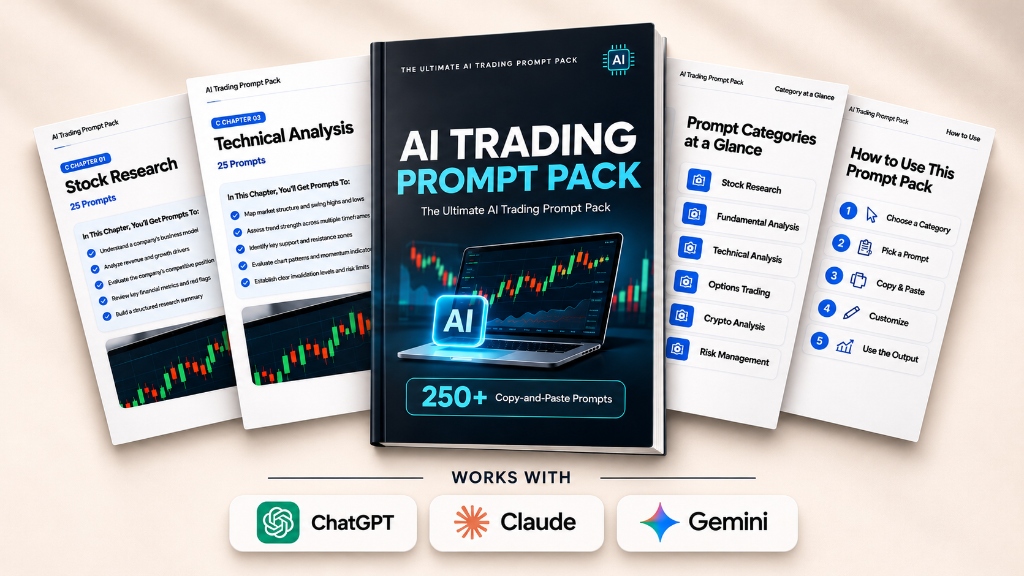
- 250+ ready-to-use prompts organized into 14 categories
- Stock research prompts for building structured checklists
- Technical analysis prompts for learning and organizing chart ideas
- Risk management prompts for position sizing and stop-loss planning
- Trade journaling prompts for logging and reviewing trades
- Psychology and discipline prompts for managing emotional habits
- A clean, print-ready PDF you can read on any device or print out
Everything is written in plain language, so you don’t need advanced knowledge to start using it.
Benefits of Ready-Made Trading Prompts
You could write every prompt yourself. Many people try. Here’s why a ready-made set can be worth it:
- Saves time: No more staring at a blank chat box wondering what to ask.
- Better answers: Structured prompts usually produce clearer, more useful responses than vague ones.
- Covers blind spots: A full pack reminds you of areas you might forget, like risk and psychology.
- Builds consistency: Using the same prompts each time creates a repeatable routine.
- Beginner-friendly: You learn what good questions look like by using good examples.
If you want to skip the trial and error, you can explore the AI Trading Prompt Pack and see exactly what’s included.
How Beginners and Experienced Traders Can Use It
BeginnersIf you’re a beginner
Start small. Pick three prompts: one for research, one for risk, and one for journaling. Use them for two weeks. Focus on learning the process, not on making money. Consider practicing with a demo account first, so you can build habits without risking real funds.
ExperiencedIf you’re experienced
You probably already have a strategy. Use the pack to tighten it. Run your existing trades through the review prompts, stress-test your rules, and use the psychology prompts to spot habits that cost you. Customize any prompt to fit your style.
Frequently Asked Questions
Will AI trading prompts make me profitable?
No. Nothing can promise that. Prompts help you prepare, organize, and review. Results depend on your skill, discipline, risk management, and market conditions.
Is this trading software or a signal service?
No. It’s a digital collection of prompts you use with an AI tool. It doesn’t place trades or tell you what to buy or sell.
Do I need to know how to use ChatGPT already?
Basic familiarity helps, but the prompts are copy-and-paste friendly. If you can type into a chat box, you can use them.
Can beginners use AI trading prompts?
Yes. These AI trading prompts for beginners are written in plain language, and they help you learn what to ask and why.
Does it work with tools other than ChatGPT?
The prompts are designed for ChatGPT prompts for traders, but they generally work with other AI chat tools too (such as Claude or Gemini). Results may vary by tool.
Can AI give me wrong information?
Yes. AI can make mistakes or invent details. Always double-check facts, figures, and news with trusted sources before acting on anything.
Is this financial advice?
No. It’s educational material only. Please speak with a licensed professional if you need personal financial advice.
Final Thoughts
Trading is hard. Not because the charts are complicated, but because staying disciplined is hard.
A good process won’t remove risk, and no tool can promise results. But a clear routine, written rules, honest journaling, and smart risk habits can make you a more prepared trader. An AI trading prompt pack gives you a head start on all of it, without the hours of figuring out what to ask.
If you’re ready to build a calmer, more organized approach to trading, get the AI Trading Prompt Pack and start your first prompt today. Pick one habit, run it for two weeks, and see how it feels to trade with a plan.
The Ultimate AI Trading Prompt Pack
250+ copy-and-paste prompts across 14 categories for stock research, technical analysis, risk management, and trade journaling.