
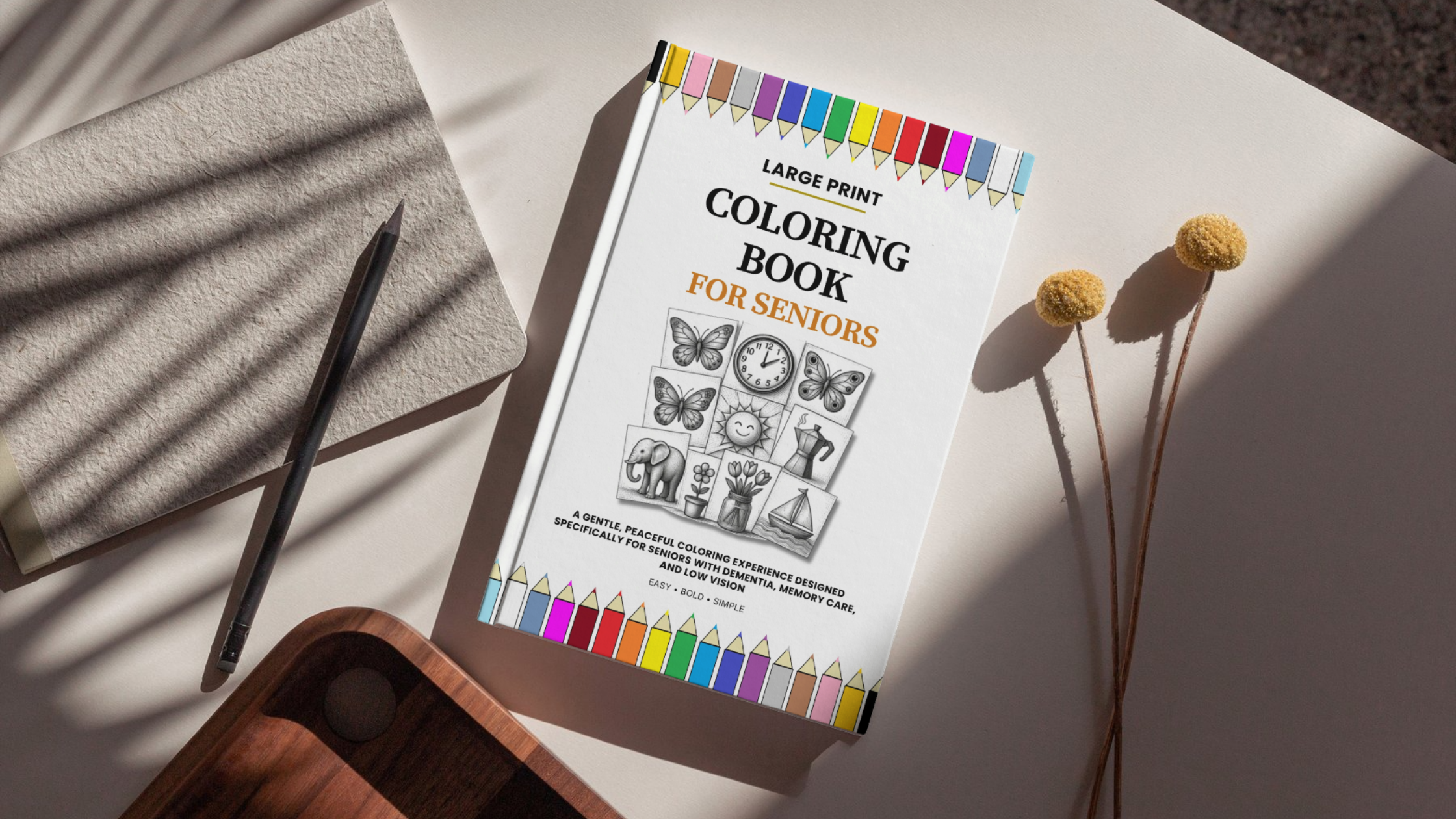
Finding the right coloring book for seniors with dementia can feel overwhelming, but it doesn’t have to be. If you’ve ever tried to find a good activity for an aging parent or a memory care resident, you know how hard it is to find something that actually works: something calm, simple, and easy enough that it doesn’t frustrate them within five minutes.
Most adult coloring books are too complicated. The lines are thin, the images are intricate, and even someone with fully sharp vision can feel overwhelmed. For a senior dealing with dementia, Alzheimer’s, or fading eyesight, those books don’t stand a chance.
That’s exactly the problem this large print coloring book for seniors was made to solve.
What Makes a Coloring Book Right for Seniors? (Most Get This Wrong)
Not every “adult coloring book” belongs in the hands of a 78-year-old with macular degeneration or early-stage Alzheimer’s. Most of them are made for hobbyists who want a challenge. That’s fine, but it’s a completely different use case.
For older adults, especially those in memory care or living with cognitive decline, the coloring book needs to do a few specific things:
- The lines need to be thick and dark enough to see without squinting
- The subjects need to be familiar with things that spark recognition, not confusion
- One image per page, not four crammed together
- No bleed-through when the markers go on
This coloring book for adults with dementia and low vision checks every single one of those boxes, which is more than I can say for most of what’s on Amazon right now.
Who This Book Was Made For
Let me be straightforward about who this is actually useful for, because the audience matters.
Seniors at home. If your mom or dad is still living independently but spends a lot of afternoons restless and understimulated, this gives them something real to do. Not passive screen time. Something that requires their hands and their attention.
Memory care and assisted living residents. This is already being used in care settings because occupational therapists know what they’re looking for. The large format, the bold outlines, the labeled images. All of that makes group coloring sessions go smoothly.
Caregivers. Whether you’re a professional caregiver or an adult child visiting on weekends, having a coloring book that your loved one can actually engage with changes the tone of those visits. It gives you something to do together, side by side.
Occupational therapists. Coloring supports fine motor skills and focused attention. Simple, low-stakes, achievable. That’s the therapeutic sweet spot, and this book sits squarely in it.
What’s Actually Inside the Book
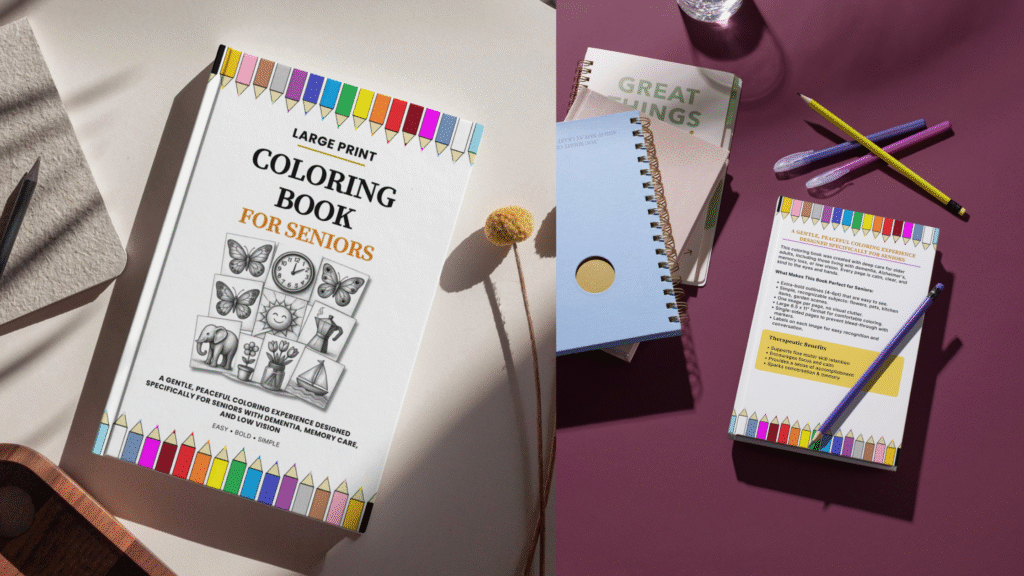
Here’s what the large print coloring book for seniors by Ethan Cole includes, and why each choice was intentional:
Extra-Bold Outlines (4–6pt)
This is not a small detail. Standard coloring book lines are too thin for someone with low vision or shaky hands. At 4–6pt, these outlines are easy to see, easy to stay inside, and forgiving enough when hands aren’t perfectly steady.
Simple, Familiar Subjects
Flowers. Kitchen objects. Pets. Garden scenes. These aren’t random choices. They’re the kinds of images that spark memory and recognition. A sunflower, a teacup, a cat sitting in a window. Subjects a senior can look at and feel something about.
One Image Per Page
No clutter. No visual noise. Just one clean image, centered, with room to breathe. For someone with attention difficulties or cognitive fatigue, this matters more than most people realize.
Large 8.5 x 11″ Format
Standard book size, comfortable to hold, comfortable to work on, whether it’s flat on a table or in someone’s lap.
Single-Sided Pages
This means markers don’t bleed through to the next page. Sounds obvious, but a shocking number of coloring books still skip this. It ruins the experience for anyone using anything thicker than a pencil.
Labeled Images
Each image has a label. This is one of those thoughtful small touches that sets this coloring book for seniors with dementia apart from generic options. A labeled image gives something to say out loud, something to connect to memory, something to build a conversation around.
The Therapeutic Side of Coloring (It’s More Than Keeping Busy)
There’s a reason occupational therapists use coloring as a therapeutic tool.
For someone with Alzheimer’s or dementia, the act of picking up a crayon, choosing a color, and filling in a shape is a small loop of intention and completion. That matters. The brain gets a mild win. The hands stay active. Focus narrows to something manageable.
Research on therapeutic art activities in dementia care consistently points to a few benefits: reduced agitation, improved mood, and a sense of accomplishment that doesn’t require memory or verbal ability to feel real.
This easy coloring book for elderly adults is built around exactly that. It’s not trying to be art therapy in a clinical sense. It’s just built to let someone sit quietly for 20 minutes and feel good about what they made.
Why This Is a Genuinely Good Gift Idea
If you’re shopping for a parent, grandparent, or someone in a care facility, this is a better gift than most things in the “senior gift” category.
It’s useful immediately. It doesn’t require batteries or Wi-Fi. It’s not another scented candle. And it gives you something to do with them when you visit. You can sit at the kitchen table, color the same page, and just be there together.
A good set of colored pencils or broad-tip markers alongside this coloring book for seniors with low vision makes for a complete, thoughtful, and genuinely practical gift.
Frequently Asked Questions
Is this coloring book suitable for someone with Alzheimer’s?
Yes. The images are simple, familiar, and labeled, which helps with recognition. The thick outlines and uncluttered pages make it accessible even at moderate stages of cognitive decline. It’s one of the few coloring books for Alzheimer’s patients that was genuinely designed with that use case in mind.
What age range is this for?
It’s built for older adults, but there’s no strict age range. Anyone with low vision, limited fine motor control, or a preference for simple designs would find it comfortable to use.
What coloring tools work best with this book?
Broad-tip markers, colored pencils, or crayons all work well. Because the pages are single-sided, even wet markers won’t bleed through and ruin the next image.
Can this be used in a group activity setting?
Absolutely. Memory care facilities and assisted living communities already use this format for group sessions. Each resident can work on their own page at their own pace without any stress or competition.
Where can I buy it? It’s available on Amazon. Click here to get the large print coloring book for seniors on Amazon.
The Bottom Line
If you’re looking for a coloring book for a senior, whether they have dementia, Alzheimer’s, low vision, or just want something calm and simple, this is one of the better options out there.
It’s not overpriced. It’s not flashy. It’s just carefully made for the people who will actually use it.
Pick up the large print coloring book for seniors here. It ships quickly and makes for a gift that’s immediately usable, not just well-intentioned.
Published as part of a review of senior activity and wellness resources. The link above is an affiliate link. Purchasing through it supports this site at no additional cost to you.